When people search “9 line acronym”, they usually want one of two things:
- The official 9-Line MEDEVAC acronym used in military emergency communication.
- Clear, simple, civilian-friendly alternatives or reinterpretations that make the 9-Line easier to remember, teach, or explain.
Because the official 9-Line format is often confusing, overly technical, or hard to memorize, readers struggle with:
- remembering each line,
- understanding how each line is used in real scenarios,
- explaining it clearly to others (students, recruits, cadets),
- finding simplified versions,
- or locating creative alternatives for training, blogging, or instructional content.
This article solves all of those pain points.
You’ll get:
- A clear, friendly explanation of what the 9 Line acronym means.
- The official 9 Line breakdown (in simple language).
- 30 creative 9-line-inspired acronyms (meaning + example + when to use).
- Guidance on how to choose the right acronym depending on tone, clarity, or teaching purpose.
Let’s dive in.
What Is the 9 Line Acronym? (Simple Explanation)
The 9 Line acronym is a standardized nine-step communication format used by military personnel to request medical evacuation (MEDEVAC) during emergencies. Each “line” represents critical information—location, injuries, resources, and conditions—needed to guide rescue teams quickly and accurately.
In short:
👉 9 Line = 9 essential pieces of information required for a safe and fast emergency medical evacuation.
It is:
- fast
- structured
- life-saving
- high-pressure
- used globally
But because it’s dense, technical, and stressful to recall, many people search for simplified or creative alternatives—which we’ll cover shortly.
The Official 9 Line MEDEVAC Format
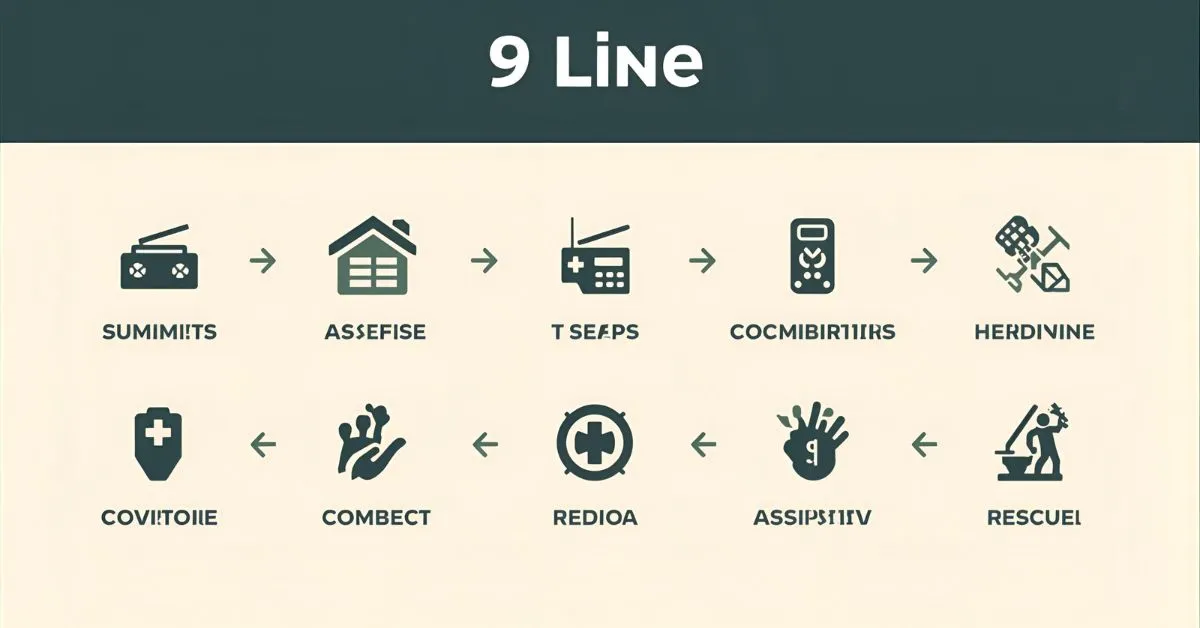
Here’s the official version in everyday language:
- Location – Exact coordinates or GPS point of the pick-up site.
- Radio Frequency & Call Sign – How rescuers contact you.
- Number of Patients (by Priority) – Urgent? Routine?
- Special Equipment Needed – Ventilator? Extraction device?
- Number of Patients (by Type) – Litter? Ambulatory?
- Security at Pick-Up Site – Safe? Hostile? Requires escort?
- Pick-Up Marking Method – Panels, flares, smoke, strobe, etc.
- Patient Nationality/Status – Military? Civilian?
- Chemical / Biological / Nuclear Threat – Any contamination present.
If you’re teaching new recruits or explaining this to beginners, this simple version is the most reader-friendly structure.
Why People Search for 9 Line Acronym Alternatives
User intent usually includes:
- wanting simplified memory aids,
- needing training-friendly words,
- creating blog, educational, or YouTube content,
- avoiding overly technical jargon,
- developing civilian-friendly explanations.
So below are 30 creative, easy-to-remember alternatives that express the purpose of the 9 Line—clarity, emergency response, structure, and speed.
30 Creative Acronym Alternatives for “9 Line” (Meaning + Example + When to Use)
These are not replacements for the official 9 Line—these are creative, educational aids used to simplify training and general understanding.
1. RLF – Rapid Life Framework
Meaning: A fast pattern for life-saving steps.
Example: “Teach recruits the RLF first to reduce confusion later.”
When to Use: Training new personnel.
2. ECS – Emergency Communication Sequence
Meaning: Ordered flow of life-saving information.
Example: “Use the ECS to drill accurate reporting.”
When to Use: For civilian training workshops.
3. F9S – First 9 Steps
Meaning: The nine essential steps in crisis reporting.
Example: “Just follow the F9S—line-by-line.”
When to Use: Simple memory tool.
4. SML – Structured Medical Lines
Meaning: Organized lines for medical communication.
Example: “SML helps remove panic during emergencies.”
When to Use: Classroom explanation.
5. RDL – Rescue Data Lineup
Meaning: What rescuers need to know before moving.
Example: “Keep your RDL accurate for quick extraction.”
When to Use: For cadet worksheets.
6. C9R – Critical 9 Requirements
Meaning: Nine requirements for evacuation clarity.
Example: “Memorize the C9R to avoid errors.”
When to Use: Quick memorization.
7. MBC – Mission-Basic Communication
Meaning: Basic but essential mission communication data.
Example: “MBC is the backbone of every MEDEVAC call.”
When to Use: Early-stage training.
8. PCE – Priority Communication Essentials
Meaning: The essentials you must say first.
Example: “Start with PCE to avoid delays.”
When to Use: Field practice.
9. SEC – Sequential Emergency Code
Meaning: A coded flow of emergency information.
Example: “The SEC keeps everyone aligned.”
When to Use: Multi-force training.
10. N9C – Nine-Code Checklist
Meaning: A checklist of nine codes.
Example: “Always revert to the N9C when stressed.”
When to Use: Stress-resistant training.
11. LSR – Life Support Report
Meaning: Report structure supporting life-saving actions.
Example: “Your LSR must be flawless.”
When to Use: Medical-focused drills.
12. CER – Crisis Event Reporting
Meaning: Structured reporting during emergencies.
Example: “With CER, even civilians can relay info correctly.”
When to Use: Civilian crisis courses.
13. L9F – Line-9 Framework
Meaning: A framework of nine essential lines.
Example: “L9F makes memorization easier.”
When to Use: Introductory guides.
14. UMC – Unified Medical Communication
Meaning: A unified reporting style.
Example: “UMC ensures cross-unit understanding.”
When to Use: Multi-unit training.
15. ERG – Emergency Response Grid
Meaning: Grid-like structured steps.
Example: “ERG helps visualize the process.”
When to Use: Infographics, slides.
16. LPS – Life Protection Steps
Meaning: Steps that protect human life.
Example: “The LPS should guide your decisions.”
When to Use: Basic field training.
17. SIR – Situation Information Relay
Meaning: Relaying vital situational information.
Example: “Your SIR determines how fast help arrives.”
When to Use: Radio practice.
18. RNE – Rescue Navigation Essentials
Meaning: Data needed to navigate toward the casualty.
Example: “Your RNE must be precise.”
When to Use: Navigation-heavy missions.
19. ILS – Immediate Life Signals
Meaning: Information signaling immediate needs.
Example: “Keep the ILS short and sharp.”
When to Use: High-pressure calls.
20. MTC – Medical Transmission Code
Meaning: Transmission format for medical needs.
Example: “Every team should learn the MTC.”
When to Use: Medical detail training.
21. RMC – Rescue Message Code
Meaning: The message code for rescue teams.
Example: “RMC prevents miscommunication.”
When to Use: Civilian rescue classes.
22. CFS – Critical Field Steps
Meaning: Field steps that must be completed.
Example: “CFS helps new trainees visualize the process.”
When to Use: Drill sessions.
23. FDC – Field Data Chain
Meaning: The chain of data required.
Example: “Never break the FDC.”
When to Use: Field troubleshooting.
24. GMS – Ground Medical Sequence
Meaning: The sequence for ground-based emergencies.
Example: “Use GMS for land missions.”
When to Use: Ground unit training.
25. TCR – Tactical Communication Route
Meaning: The route of communication in emergencies.
Example: “Follow the TCR for clean reporting.”
When to Use: Tactical instructors.
26. NFS – Nine-Format Sequence
Meaning: A nine-part format for emergencies.
Example: “The NFS is simpler than the traditional form.”
When to Use: Beginner-friendly classes.
27. LMC – Life-Mission Communication
Meaning: Mission-critical life-saving communication.
Example: “Your LMC is everything in the field.”
When to Use: Emotional impact training.
28. SGC – Situation Grid Code
Meaning: A coded grid of nine steps.
Example: “The SGC works well for visual learners.”
When to Use: Classroom chalkboard teaching.
29. RQS – Rescue Query Sequence
Meaning: The sequence of questions rescuers need answered.
Example: “Use RQS during simulations.”
When to Use: Interview-style drills.
30. P9L – Priority 9 Lines
Meaning: The nine priority lines in any emergency report.
Example: “P9L is a simplified version for civilians.”
When to Use: Non-military audiences.
How to Choose the Right Acronym
✔ For teaching beginners
Use: N9C, F9S, L9F, SEC, ECS
✔ For military-style training
Use: C9R, RDL, LSR, MTC, TCR
✔ For civilian emergency training
Use: CER, UMC, RMC, FDC
✔ For infographics or slides
Use: ERG, SGC, GMS
Conclusion
The 9 Line acronym is deeply important in emergency and military settings—but it’s also famously hard to memorize. By using simplified, creative, and training-friendly alternatives, instructors, writers, and learners can convey the same structured communication without overwhelming newcomers.
Whether you’re teaching recruits, writing an article, creating a training manual, or just trying to understand the 9 Line yourself, these 30 alternatives offer clarity, confidence, and communication accuracy.
✅ FAQ Section
1. What is the 9 Line acronym?
The 9 Line acronym is a nine-step communication format used to request MEDEVAC support in military emergencies. Each line provides a critical piece of information to guide rescue teams.
2. Why is the 9 Line hard to remember?
It’s highly technical and used under stress, making memorization difficult for beginners, civilians, and new recruits.
3. Is the 9 Line only for the military?
Primarily yes, but simplified versions are often used in civilian emergency training and educational content.
4. Are the 30 alternatives official?
No. They are creative, training-friendly acronyms designed to help learners understand or explain the 9 Line more easily—never as substitutes for real operational use.
5. Can I use these acronyms in teaching?
Absolutely. These alternatives are ideal for instructors, cadets, students, and blog writers who want a more approachable way to explain complex emergency communication.
6. Why do people search for 9 Line acronym alternatives?
Users want easier memory aids, simplified explanations, and creative terminology for educational or content-creation purposes.
7. What’s the best way to learn the official 9 Line?
Start with a simplified version, practice line-by-line, then gradually integrate the official terminology through repetition and scenario training.