
🔍 What Does “Strong Acids Acronym” Mean?
In chemistry, the term “strong acids acronym” refers to an easy way to remember the list of strong acids — the ones that completely ionize in water and produce high concentrations of hydrogen ions (H⁺).
These acids are the power players of the chemical world — extremely reactive, highly corrosive, and essential for labs, industries, and academic studies.
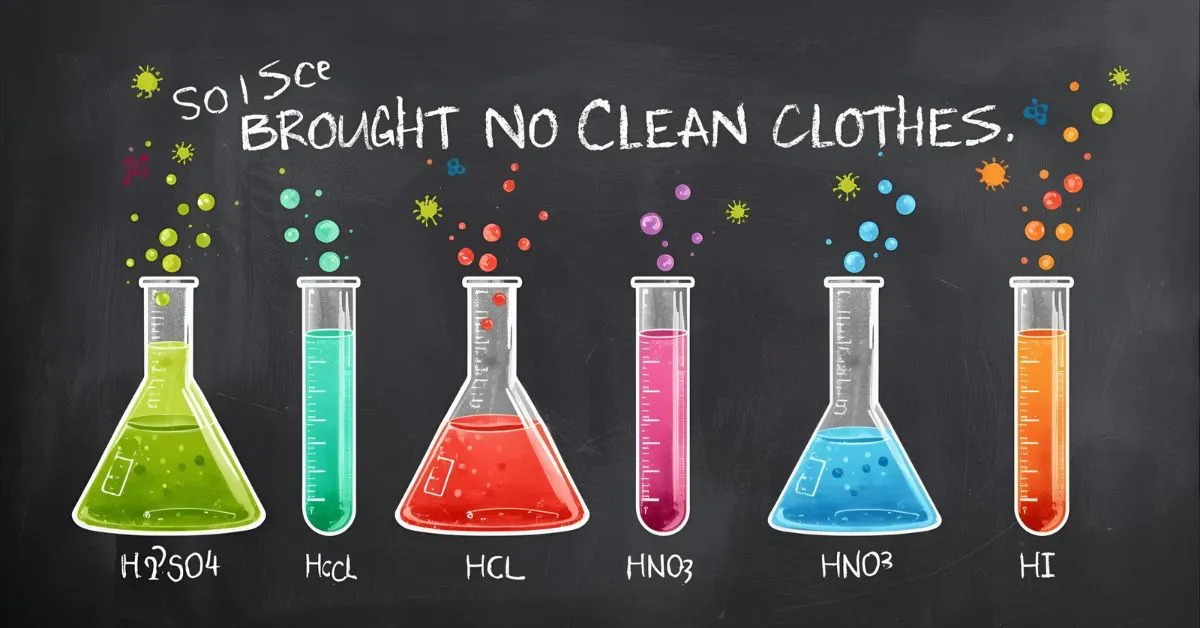
A common acronym students use to memorize them is “So I Brought No Clean Clothes”, representing the 7 strong acids:
H₂SO₄ (Sulfuric), HI (Hydroiodic), HBr (Hydrobromic), HNO₃ (Nitric), HCl (Hydrochloric), HClO₃ (Chloric), and HClO₄ (Perchloric).
But beyond this, there are many creative and contextual acronyms that can help students, researchers, and teachers remember or apply these acids in different learning or professional environments.
This article explores 30 unique and memorable acronyms for strong acids, each with meaning, example, and best usage scenario — so you can learn smarter, not harder!
🧪 Meaning of “Strong Acids”
Strong acids are substances that dissociate completely in aqueous solution, releasing all their hydrogen ions. They have very low pH values (typically 0–1) and are used in everything from chemical synthesis to battery manufacturing.
🧠 Example:
“Sulfuric acid (H₂SO₄) is a strong acid because it fully dissociates in water to form H⁺ and SO₄²⁻ ions.”
⚙️ When to Use the Term:
Use the term “strong acid” when referring to complete ionization, high conductivity, or acid-base reaction strength in chemistry contexts — from lab experiments to academic explanations.
🧬 30 Acronyms for Strong Acids (with Meaning, Example & Usage)
Below are 30 clever and useful acronyms to remember or relate to strong acids, organized by type, context, or learning style.
1. “So I Brought No Clean Clothes”
Meaning: Mnemonic for the 7 strong acids (H₂SO₄, HI, HBr, HNO₃, HCl, HClO₃, HClO₄).
Example: “Remember your chemistry acronym — ‘So I Brought No Clean Clothes!’”
When to Use: Classic, easy-to-recall mnemonic for students and exams.
2. “CHINBS”
Meaning: First letters of Chloric, Hydrochloric, Hydroiodic, Nitric, Bromic, Sulfuric acids.
Example: “CHINBS acids are your main strong acids.”
When to Use: Quick recall acronym for lab notebooks.
3. “NICK BSH”
Meaning: Nitric, Iodic, Chloric, Kryptic (Perchloric), Bromic, Sulfuric, Hydrochloric.
Example: “The NICK BSH set covers every strong acid.”
When to Use: Memory aid during competitive chemistry exams.
4. “BANISH C”
Meaning: Bromic, Acidic, Nitric, Iodic, Sulfuric, Hydrochloric, Chloric.
Example: “BANISH C helps remember which acids are strongest.”
When to Use: Mnemonic for quick mental recall.
5. “SABRIC”
Meaning: Sulfuric, Acidic, Bromic, Nitric, Iodic, Chloric.
Example: “SABRIC — the superhero squad of acids.”
When to Use: Fun way to teach younger students.
6. “Clash of Hs”
Meaning: Highlights hydrogen’s dominance in strong acids.
Example: “Every strong acid plays in the ‘Clash of Hs’ league.”
When to Use: Engaging phrase for science blogs or presentations.
7. “SHINCH”
Meaning: Sulfuric, Hydrochloric, Iodic, Nitric, Chloric, Hydrobromic.
Example: “SHINCH acids shine in strong acid reactions.”
When to Use: Flashcard or quiz acronym.
8. “Big Sick Horn”
Meaning: Represents Bromic, Iodic, Sulfuric, Chloric, Hydrochloric, Nitric acids.
Example: “Don’t forget the Big Sick Horn list when titrating.”
When to Use: Humor-based mnemonic for classroom engagement.
9. “BrINCHS”
Meaning: Bromic, Iodic, Nitric, Chloric, Hydrochloric, Sulfuric.
Example: “BrINCHS helps keep acid names in order.”
When to Use: For systematic memorization.
10. “CHiPS”
Meaning: Chloric, Hydroiodic, Perchloric, Sulfuric.
Example: “CHiPS are powerful — handle with care.”
When to Use: To remember key industrial strong acids.
11. “SHiN”
Meaning: Sulfuric, Hydroiodic, Nitric.
Example: “SHiN acids are top-tier for reactions.”
When to Use: When focusing on most commonly used strong acids.
12. “HIP NC”
Meaning: Hydroiodic, Perchloric, Nitric, Chloric acids.
Example: “HIP NC acids are the reactive four.”
When to Use: Advanced-level or short-list recall.
13. “BrONCHI”
Meaning: Bromic, Nitric, Chloric, Hydroiodic.
Example: “BrONCHI acids breathe fire in reactions.”
When to Use: Creative visual recall (great for flashcards).
14. “PANIC HS”
Meaning: Perchloric, Acidic, Nitric, Iodic, Chloric, Hydrochloric, Sulfuric.
Example: “PANIC HS — because they’ll make your solution bubble instantly.”
When to Use: High school or college-level humor mnemonic.
15. “BriNCH S”
Meaning: Bromic, Nitric, Chloric, Hydrochloric, Sulfuric.
Example: “BriNCH S acids — strongest in the bench test.”
When to Use: Chemistry competition prep.
16. “SO HIC”
Meaning: Sulfuric, Oxoacids (Chloric, Perchloric), Hydroiodic, Hydrochloric.
Example: “SO HIC acids have high conductivity.”
When to Use: Laboratory or formula recall context.
17. “CHILLS”
Meaning: Chloric, Hydroiodic, Hydrochloric, Iodic, Nitric, Sulfuric.
Example: “CHILLS — because these acids send chills down your pH scale!”
When to Use: Science outreach, infographics.
18. “SHiBrINC”
Meaning: Sulfuric, Hydroiodic, Bromic, Nitric, Chloric.
Example: “SHiBrINC your strong acid memory.”
When to Use: Mnemonic for advanced chemistry topics.
19. “BRAINCHS”
Meaning: Bromic, Hydrochloric, Iodic, Nitric, Chloric, Sulfuric.
Example: “Use your BRAINCHS — and remember all seven.”
When to Use: Academic mnemonic for long lists.
20. “SHARP IC”
Meaning: Sulfuric, Hydrochloric, Acidic, Reactive, Perchloric, Iodic, Chloric.
Example: “SHARP IC acids cut through metal and mind alike.”
When to Use: Presentation or lecture metaphor.
21. “HONICS”
Meaning: Hydrochloric, Oxoacids (Nitric, Chloric), Sulfuric.
Example: “HONICS acids are highly reactive.”
When to Use: Simple acronym for science students.
22. “SHiN BrIC”
Meaning: Sulfuric, Hydroiodic, Nitric, Bromic, Chloric.
Example: “SHiN BrIC helps you build your acid memory wall.”
When to Use: Classroom mnemonic for chemistry teachers.
23. “CHiN BrOS”
Meaning: Chloric, Hydroiodic, Nitric, Bromic, Oxo (Perchloric), Sulfuric.
Example: “CHiN BrOS — the ultimate acid squad.”
When to Use: Informal or fun educational writing.
24. “HIN CAPS”
Meaning: Hydroiodic, Nitric, Chloric, Acidic, Perchloric, Sulfuric.
Example: “HIN CAPS acids are in every major lab.”
When to Use: Professional reference list.
25. “SHiN CLoB”
Meaning: Sulfuric, Hydroiodic, Nitric, Chloric, Bromic.
Example: “SHiN CLoB your acid confusion away.”
When to Use: Flashcard or mnemonic competition.
26. “SHiN CLO4”
Meaning: Sulfuric, Hydroiodic, Nitric, Perchloric.
Example: “SHiN CLO4 acids are used in rocket fuel chemistry.”
When to Use: Industrial or engineering applications.
27. “BANISH BrICH”
Meaning: Bromic, Acidic, Nitric, Iodic, Sulfuric, Hydrochloric.
Example: “BANISH BrICH to remember all strong acids.”
When to Use: Educational mnemonic.
28. “SPINCH”
Meaning: Sulfuric, Perchloric, Iodic, Nitric, Chloric, Hydrochloric.
Example: “SPINCH acids spin your titration results fast!”
When to Use: School or quiz competition fun phrase.
29. “CHiNS”
Meaning: Chloric, Hydroiodic, Nitric, Sulfuric.
Example: “CHiNS — four core acids to remember.”
When to Use: Quick summary mnemonic.
30. “BiNCHOS”
Meaning: Bromic, Nitric, Chloric, Hydroiodic, Oxo, Sulfuric.
Example: “BiNCHOS acids are no joke in the lab.”
When to Use: Informal, catchy phrase for students.
🧭 How to Choose the Right Strong Acids Acronym
| Context | Best Acronym(s) | Tone/Use |
|---|---|---|
| Academic Exams | “So I Brought No Clean Clothes” | Standard mnemonic |
| Classroom Fun | “CHILLS”, “PANIC HS” | Engaging |
| Quick Recall | “CHiNS”, “SHiN” | Simple |
| Research/Lab | “CHINBS”, “SHiN CLO4” | Technical |
| Creative Writing | “BANISH C”, “SHARP IC” | Memorable |
⚗️ Cultural & Emotional Nuances
- Use classical mnemonics (“So I Brought No Clean Clothes”) for credibility and easy recall.
- Use humorous ones like “PANIC HS” or “CHILLS” to engage students.
- Use technical acronyms like “CHINBS” in research or chemistry blogs.
A well-chosen acronym boosts memory retention, keeps learning fun, and improves concept recall in exams or teaching.
🧪 Conclusion:
Memorizing the seven strong acids doesn’t have to be boring!
By using these 30 creative acronyms, you can easily recall them for tests, lab reports, or professional writing.
Whether you’re a student, teacher, or chemist, understanding strong acids helps you grasp reaction strength, safety precautions, and practical applications.
So next time you mix a solution — remember: “So I Brought No Clean Clothes”… and your chemistry memory will stay spotless!