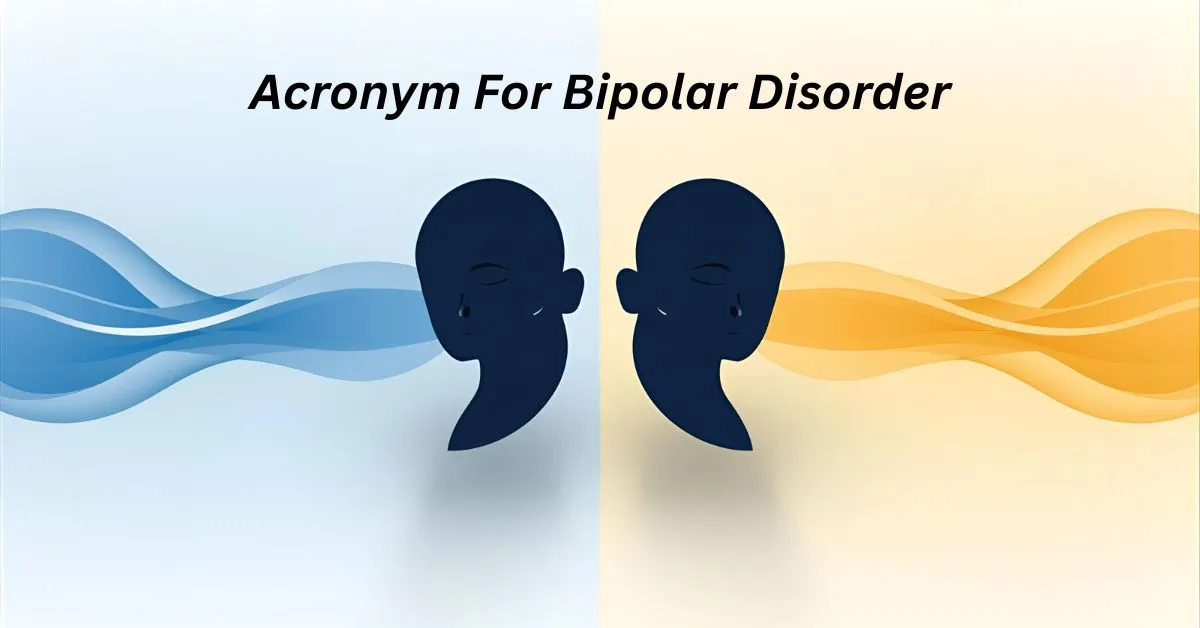
When people search for the acronym for bipolar disorder, they often look for short, memorable letter-based expressions to describe emotional contrast, mood swings, or dual feelings in a way that helps simplify complex inner states.
While BD and BPD are the only medically recognized abbreviations related to bipolar disorder, writers often prefer using creative acronyms to express emotional fluctuation without referencing a clinical diagnosis.
This article explores 30 creative acronym alternatives designed to express mood changes, emotional duality, inner conflict, or rapid emotional shifts — all written in a respectful, non-medical, and non-diagnostic manner. Each acronym includes:
- Meaning
- Example sentence
- When to use
30 Creative Acronym Alternatives for Emotional Duality
Below are acronyms that express emotional movement, not medical conditions. They’re great for writers, content creators, mental-health bloggers, teachers, and anyone wanting expressive, respectful language.
1. MWD – Mixed Wave Dynamics
Meaning: Emotional waves rising and falling.
Example: “Today felt like classic MWD — calm, then energized, then calm again.”
When to Use: For describing normal day-to-day mood fluctuations.
2. TME – Two-Mood Energy
Meaning: Switching between energised and quiet modes.
Example: “My weekend was total TME — social on Saturday, silent on Sunday.”
When to Use: When explaining balanced dual emotional states.
3. SFT – Shift-Flow Temperament
Meaning: A natural flow of mood changes.
Example: “Her SFT made her creative bursts unpredictable but exciting.”
When to Use: Useful in creative-writing or personality descriptions.
4. DVC – Dual-Vibe Current
Meaning: Feeling two strong vibes at once.
Example: “I’m in a DVC — excited for the trip but stressed about planning.”
When to Use: For mixed emotions happening simultaneously.
5. EMC – Emotional Motion Cycle
Meaning: A cycle of emotional movement.
Example: “This project puts me in an EMC every time.”
When to Use: When emotions shift throughout tasks or routines.
6. MTF – Mood-Turn Frequency
Meaning: How often emotions shift.
Example: “My MTF is high during deadlines.”
When to Use: When frequency matters more than intensity.
7. CEB – Contrasting Emotion Blend
Meaning: Opposite feelings blending together.
Example: “Graduation day was a pure CEB — proud yet sentimental.”
When to Use: Great for writing about milestones.
8. HMV – High-Low Mood Variance
Meaning: Noticeable changes in emotional highs and lows.
Example: “Her HMV kept her journaling consistent.”
When to Use: When explaining mood tracking or reflection.
9. DMS – Dual-Mode State
Meaning: Switching between two emotional modes.
Example: “I’m in DMS — playful but tired.”
When to Use: Everyday emotional nuance.
10. SPF – Split-Pulse Feeling
Meaning: Feeling emotionally “split” or torn.
Example: “That movie gave me SPF — sad yet strangely hopeful.”
When to Use: When describing layered emotional reactions.
11. EDC – Emotional Drift Cycle
Meaning: Gradual drifting between moods.
Example: “Rainy weather puts me in an EDC.”
When to Use: Soft, subtle mood changes.
12. DMF – Dual-Mind Flow
Meaning: Two thought-states flowing at once.
Example: “DMF moments happen a lot when I’m brainstorming.”
When to Use: For creative or analytical dual thinking.
13. NMC – Natural Mood Contrast
Meaning: Normal opposite moods experienced during the day.
Example: “Morning optimism and afternoon fatigue — a typical NMC.”
When to Use: To normalize emotional change.
14. RVC – Rising-Varying Current
Meaning: Emotion that rises and shifts unpredictably.
Example: “The concert brought me into an RVC.”
When to Use: Describing emotionally stimulating scenarios.
15. LSE – Low-Shift Energy
Meaning: Small, subtle mood changes.
Example: “A quiet LSE day — nothing too intense.”
When to Use: For gentle mood shifts.
16. HSE – High-Shift Energy
Meaning: Strong change in emotional energy.
Example: “Coffee hits me and boom — HSE.”
When to Use: When shifts feel more dramatic.
17. VCM – Vibe Change Moment
Meaning: A quick switch in emotional vibes.
Example: “When I heard the good news, I had a VCM instantly.”
When to Use: For sudden emotional reactions.
18. DFC – Dual-Feeling Conflict
Meaning: Conflict between two emotional urges.
Example: “That DFC after accepting a job offer is real.”
When to Use: Big decisions, milestones, tense moments.
19. MEC – Mood Exchange Cycle
Meaning: Trading one mood for another over time.
Example: “Work stress to evening calm — a daily MEC.”
When to Use: Routine emotional changes.
20. EMX – Emotional Mix Experience
Meaning: Feeling many emotions interwoven.
Example: “Birthdays always bring an EMX.”
When to Use: Complex events or memories.
21. DMX – Dual-Mode Expression
Meaning: Expressing two emotional states outwardly.
Example: “Her DMX shows when she smiles while tearing up.”
When to Use: Describing visible emotional combinations.
22. VSD – Vibe Shift Dynamic
Meaning: How and why vibes shift over time.
Example: “The room’s VSD changed once music started.”
When to Use: Social or environmental mood shifts.
23. FMT – Feeling-Move Transition
Meaning: Transitioning from one feeling to another.
Example: “A quick FMT after reading that message.”
When to Use: Short, reaction-based shifts.
24. EBB – Emotional Back-and-Back
Meaning: Switching between two emotions repeatedly.
Example: “EBB after arguments is common.”
When to Use: Tense conversations or unresolved emotions.
25. WMC – Wave-Mood Curve
Meaning: A wave-like emotional pattern.
Example: “My WMC grows during stressful weeks.”
When to Use: When describing emotional patterns across days.
26. IMD – Inner-Mood Duality
Meaning: Carrying two internal moods at once.
Example: “IMD is normal before life changes.”
When to Use: Personal or introspective writing.
27. DBC – Dual-Balance Cycle
Meaning: Balancing opposite feelings in a cycle.
Example: “DBC days make me productive.”
When to Use: Emotional management or self-awareness.
28. ECS – Emotional Contrast State
Meaning: A contrasting emotional condition.
Example: “I’m in an ECS — excited but scared.”
When to Use: When two emotions feel equally strong.
29. TFW – Two-Feeling Wave
Meaning: A wave of two emotions rising together.
Example: “Hearing that song gives me a TFW.”
When to Use: Creative storytelling or poetry.
30. VCD – Variable-Change Drift
Meaning: Gradual drifting into new emotional territory.
Example: “My VCD after meditation is always positive.”
When to Use: When emotional change happens gently and slowly.
How to Choose the Right Acronym
Choosing the best acronym for emotional duality depends on tone and context:
Use Soft-Toned Acronyms
For gentle, natural emotional shifts:
- LSE
- EDC
- VCD
- NMC
Use Medium-Toned Acronyms
For everyday or mixed emotional experiences:
- MEC
- DMS
- VCM
- CEB
Use Strong-Toned Acronyms
For dramatic, surprising, or sudden shifts:
- HSE
- DFC
- RVC
- EMX
Use Introspective Acronyms
For writing about internal conflict or emotional depth:
- IMD
- DMF
- SPF
- TFW
Cultural & Emotional Context Notes
- Some cultures prefer softer emotional language → choose LSE, EDC, VCD.
- In digital communication, short and punchy acronyms like VCM, DMX, HSE feel more natural.
- For storytelling or poetry, choose imagery-rich acronyms like WMC, TFW, CEB.
Conclusion
Finding the right acronym for bipolar disorder—in a respectful, creative, and non-clinical way—helps writers describe emotional duality, mood shifts, and human complexity without misusing medical terminology. These 30 alternatives give you a flexible vocabulary for expressing mood changes across emotional, creative, social, or introspective contexts.
Choose soft acronyms for gentle fluctuations, strong ones for dramatic shifts, and introspective ones for deeper emotional writing. With the right acronym, your writing becomes clearer, more expressive, and more relatable.
✅ FAQ Section
1. What is the acronym for bipolar disorder?
The medically recognized abbreviations are BD or sometimes BPD, but writers often search for creative, non-clinical acronyms to express emotional duality or mood shifts without referencing a diagnosis.
2. Are the acronyms in this article medical terms?
No. All 30 acronyms provided are creative writing tools, not clinical terminology. They help describe emotional experiences respectfully.
3. Why use creative acronyms for emotional states?
Creative acronyms simplify complex feelings, improve tone clarity, and help writers express emotional dynamics in a relatable, non-medical way.
4. Are these acronyms appropriate in mental-health discussions?
Yes—when used carefully. They should not replace clinical language but can help express general emotional contrast or mood movement in conversation or writing.
5. Can I use these acronyms in storytelling or journaling?
Absolutely. These acronyms are especially helpful for characters, creative writing, journaling, poetry, and reflective content.
6. How do I choose the best acronym for my context?
Choose a soft-toned acronym for gentle moods, a medium-toned one for normal emotional shifts, and a strong-toned one for dramatic, sudden changes.
7. Are mood-shift acronyms culturally sensitive?
Yes—most are neutral. If writing for cultures that prefer softer emotional expression, select gentler acronyms like LSE, EDC, or VCD.