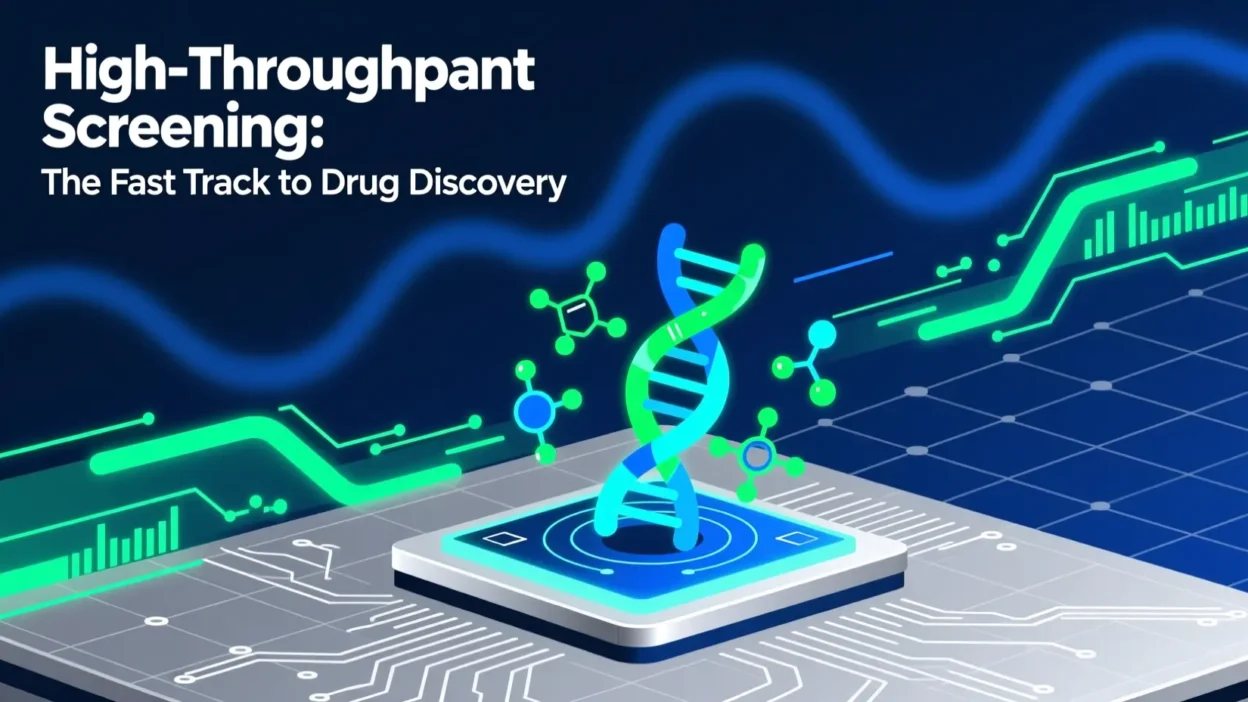
Drug discovery is a long and complex process. Scientists must test thousands of compounds to find one that can become a safe and effective medicine. In the past, this process took many years and required a lot of manual work. Today, technology has made drug discovery faster and more efficient. One of the most important tools in this progress is high-throughput screening. High-throughput screening is often called the fast track to drug discovery because it allows researchers to test many samples quickly and accurately.
What Is High-Throughput Screening
High-throughput screening, often shortened as HTS, is a method used in drug research to test a large number of chemical compounds in a short time. It uses automated machines, special tools, and computer systems to run many tests at once.
Instead of testing one compound at a time, scientists can test thousands or even millions of samples in a single experiment. Each sample is checked to see how it reacts with a specific target, such as a protein or cell. This helps researchers quickly identify which compounds may be useful as future drugs.
Why Speed Matters in Drug Discovery
Speed is very important in drug discovery. Developing a new medicine can take many years. Delays can increase costs and slow down treatment options for patients.
High-throughput screening speeds up the early stages of drug discovery. It helps researchers find promising compounds faster. By quickly removing compounds that do not work, scientists can focus on the most useful ones.
This faster process saves time, money, and effort. It also helps bring new treatments to patients sooner, especially for serious diseases.
How High-Throughput Screening Works
The process of high-throughput screening follows simple steps. First, scientists choose a target. This target is often linked to a disease, such as a protein involved in cancer or infection.
Next, many small samples are placed into tiny containers called wells. Each well contains a different compound. Automated machines add the target to each well and measure how the compound reacts.
Special sensors and software collect the results. The system then identifies which compounds show positive results. These are called “hits” and are studied further.
Automation allows this process to happen very quickly with high accuracy.
Automation and Technology in HTS
Automation is the backbone of high-throughput screening. Robots handle liquids, move samples, and run tests without human error.
Computers analyze large amounts of data generated during screening. This makes it easier to compare results and identify patterns.
Modern technology ensures that tests are consistent and reliable. It also reduces the need for manual labor, allowing scientists to focus on analysis and decision-making.
This combination of automation and data analysis is what makes high-throughput screening so powerful.
Benefits of High-Throughput Screening
High-throughput screening offers many benefits in drug discovery.
One major benefit is efficiency. Thousands of compounds can be tested in the time it once took to test only a few.
Another benefit is accuracy. Automated systems reduce human mistakes and provide consistent results.
HTS also supports innovation. Researchers can explore a wider range of chemical compounds, increasing the chances of finding new treatments.
Overall, high-throughput screening improves productivity and success rates in drug development.
Role in Early Drug Development
High-throughput screening plays a key role in the early stages of drug development. This is the phase where scientists search for compounds that interact well with disease targets.
Finding the right starting compound is critical. HTS helps narrow down large libraries of chemicals to a small group of promising candidates.
These candidates then go through more detailed testing. Without HTS, this early stage would be much slower and less effective.
Because of this, high-throughput screening is considered a foundation of modern drug research.
Applications Beyond Drug Discovery
Although high-throughput screening is mainly used in drug discovery, it has other applications as well.
It is used in biological research to study how cells behave. It helps scientists understand how genes and proteins work.
HTS is also used in toxicology to test chemical safety. This helps identify harmful substances early.
In biotechnology, high-throughput screening supports research in agriculture, environmental science, and diagnostics.
Challenges in High-Throughput Screening
Despite its advantages, high-throughput screening has some challenges.
Setting up HTS systems requires high investment. The equipment and technology can be expensive.
Managing large amounts of data can also be difficult. Proper data analysis tools are needed to avoid false results.
Another challenge is quality control. Not all positive results lead to successful drugs. Further testing is always required.
Even with these challenges, the benefits of HTS far outweigh the limitations.
Improving Accuracy and Reliability
Scientists are always working to improve high-throughput screening methods.
Better sensors and improved software help increase accuracy. New techniques reduce false positives and improve data quality.
Combining HTS with other methods, such as computer modeling, also improves results. This creates a more reliable drug discovery process.
Continuous improvement ensures that high-throughput screening remains effective and trusted.
Impact on Modern Medicine
High-throughput screening has had a major impact on modern medicine.
Many treatments available today began with HTS research. It has helped discover drugs for cancer, infections, and chronic diseases.
By speeding up discovery, HTS supports faster responses to health challenges. This is especially important during global health emergencies.
High-throughput screening continues to shape the future of healthcare and medicine.
The Future of High-Throughput Screening
The future of high-throughput screening looks promising. Advances in automation, artificial intelligence, and data science are making it even more powerful.
Smaller, faster systems are being developed. These allow more flexible and cost-effective screening.
As technology improves, high-throughput screening will become more accessible and efficient. It will continue to play a key role in discovering new medicines.
Conclusion
High-throughput screening is truly the fast track to drug discovery. It allows scientists to test thousands of compounds quickly and accurately. By saving time and resources, it helps bring new treatments to patients faster. High-throughput screening has transformed how drugs are discovered and developed. As technology continues to advance, its role in medical research will only grow stronger.