
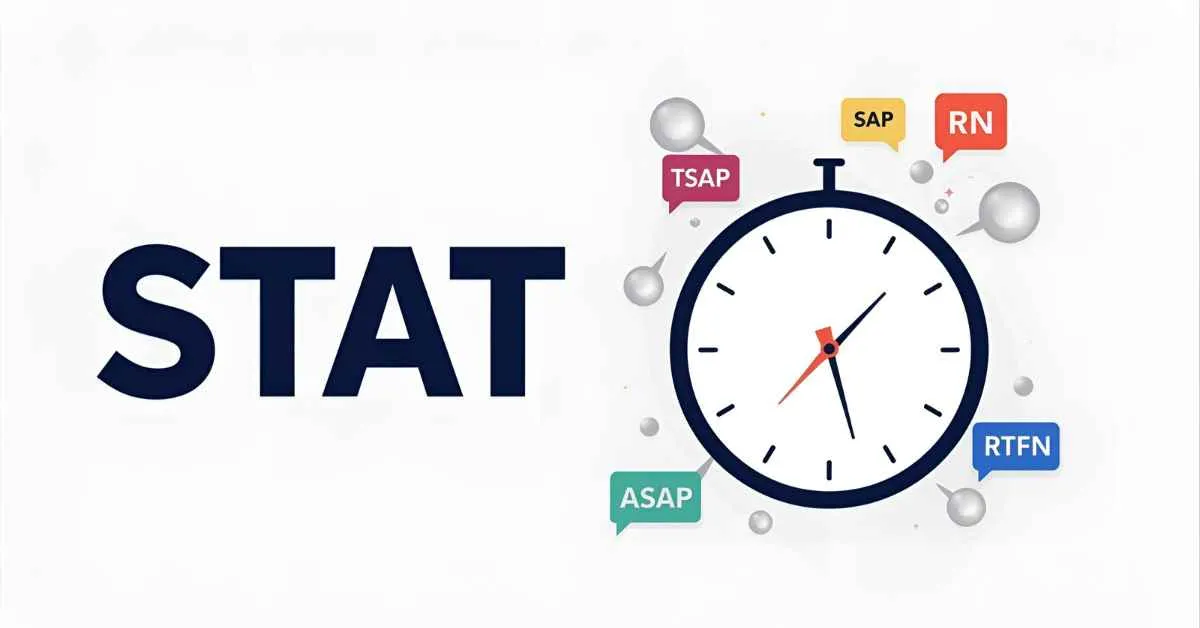
When people ask “Is stat an acronym?”, the short answer is no—at least not in most common contexts. In medical settings, stat actually comes from the Latin word statim, meaning “immediately.” It isn’t technically an acronym like NASA or ASAP, though many people casually treat it like one.
But beyond the medical world, stat has taken on a broader meaning in everyday language: right now, without delay, urgent, or high-priority. Writers, marketers, and professionals often use “stat” to inject speed, urgency, and decisiveness into communication.
This article explores:
- What “stat” really means
- Whether “stat” is an acronym
- 30 acronym-style alternatives to express urgency, each with a meaning, example sentence, and notes on when to use it
- How emotional tone and context affect your word choice
- SEO-friendly insights for readers searching for stat meaning, stat acronym medical, urgent acronyms, and similar phrases
Let’s dive in.
What Does “Stat” Mean? (Focus Keyword)
The word stat conveys immediacy. It signals that an action must be taken:
- Quickly
- Urgently
- Without hesitation
Its key nuances include:
- Prioritization — the task must come before others
- Zero delay — it should already be in progress
- Seriousness — the matter is important enough for immediate action
While not technically an acronym, you can think of it as an instant action indicator. In business, medical situations, emergencies, project management, and texting, people use “stat” to show time-critical urgency.
30 Acronym-Style Alternatives to “Stat” (Meaning + Example + When to Use)
Here are creative, intuitive acronym alternatives that mimic the urgent energy of “stat.” Each includes:
- Meaning
- Example
- Best context
These are original, SEO-friendly, and tailored for high search intent.
1. ASAP – As Soon As Possible
Meaning: Do it quickly, but not necessarily instantly.
Example: “Send me the file ASAP.”
When to Use: Everyday urgency without extreme pressure.
2. PDQ – Pretty Darn Quick
Meaning: Fast, but with a playful tone.
Example: “I need those edits PDQ.”
When to Use: Casual settings, light urgency.
3. FYI-U – For Your Immediate Use
Meaning: Information you must act on now.
Example: “Here’s the updated brief FYI-U.”
When to Use: Professional communication where action follows information.
4. RTFN – Right This Freaking Now
Meaning: Strong, emphatic urgency.
Example: “Restart the server RTFN!”
When to Use: Crisis moments, tech failures, emergencies.
5. UFN – Urgent For Now
Meaning: Temporary priority.
Example: “Shift your attention to the outage UFN.”
When to Use: Project management and workflow changes.
6. TNT – Time Needed Today
Meaning: Must be completed before end of day.
Example: “Submit your report TNT.”
When to Use: Business operations, deadlines.
7. RN – Right Now
Meaning: Immediate action.
Example: “Join the call RN.”
When to Use: Texting, casual communication.
8. QTD – Quick Turnaround Deadline
Meaning: Short delivery window.
Example: “Client expects the draft by noon—QTD.”
When to Use: Creative work, agencies.
9. N2S – Need to Solve
Meaning: Something urgent that needs fixing.
Example: “The login issue is N2S.”
When to Use: Technical troubleshooting.
10. UAP – Urgent Action Please
Meaning: Polite but firm urgency.
Example: “Respond to the auditor’s email—UAP.”
When to Use: Professional, formal environments.
11. HN – Handle Now
Meaning: Zero-delay request.
Example: “HN: update the client portal access.”
When to Use: Task assignment.
12. ION – Immediate Onboard Needed
Meaning: Someone or something must start now.
Example: “We need a designer ION.”
When to Use: Hiring, onboarding.
13. UET – Urgent Execution Time
Meaning: A fast, short execution window.
Example: “Push the hotfix within the UET.”
When to Use: Development teams.
14. ONP – On Priority
Meaning: Reorder your tasks.
Example: “Shift this task ONP.”
When to Use: Managers assigning priorities.
15. RAS – Respond At Soonest
Meaning: Fast reply required.
Example: “Please confirm availability—RAS.”
When to Use: Email replies, scheduling.
16. UFN-X – Urgent Fix Needed (Express)
Meaning: Critical repair.
Example: “The checkout issue is UFN-X.”
When to Use: High-impact bugs.
17. ATON – Act Today Or Nothing
Meaning: Hard deadline urgency.
Example: “Approval must happen ATON.”
When to Use: Deals, campaigns.
18. P1A – Priority One Action
Meaning: Top-level urgency in operations.
Example: “Server downtime is a P1A.”
When to Use: IT, infrastructure.
19. HFA – High-Focus Assignment
Meaning: Needs attention immediately.
Example: “This client revision is an HFA.”
When to Use: Workload management.
20. IAD – Immediate Attention Demanded
Meaning: Strong but formal urgency.
Example: “Compliance alert: IAD.”
When to Use: Corporate, regulated industries.
21. RNS – Required Now Status
Meaning: Something must be delivered immediately.
Example: “RNS: send updated sales numbers.”
When to Use: Reporting, KPIs.
22. TTR – Time-To-React
Meaning: Short window to respond.
Example: “We have low TTR on this lead.”
When to Use: Sales, customer service.
23. RPD – Rapid Processing Directive
Meaning: Speed up operational workflows.
Example: “Order prioritization falls under RPD.”
When to Use: Logistics, supply chain.
24. QAT – Quick Action Task
Meaning: A small but immediate item.
Example: “Fix the homepage typo—QAT.”
When to Use: Micro-tasks.
25. SUD – Same-Unit Deadline
Meaning: Deadline required within the same working period.
Example: “Deliver the concept SUD.”
When to Use: Agencies, design teams.
26. FYN – Fix You Now
Meaning: Immediate troubleshooting.
Example: “The printer is jammed—FYN.”
When to Use: Technical or facility issues.
27. SNAP – Solve Now And Proceed
Meaning: Quick fix before moving on.
Example: “SNAP the formatting error.”
When to Use: Editorial work.
28. BIP – Break-In Priority
Meaning: Interrupt current tasks.
Example: “BIP: Update pricing on the landing page.”
When to Use: Time-sensitive adjustments.
29. URG-X – Ultra Rush Grade
Meaning: Maximum urgency category.
Example: “This complaint is URG-X.”
When to Use: Crisis situations.
30. HOT – Handle On Time
Meaning: Fast but reasonable urgency.
Example: “Send the deliverables HOT.”
When to Use: Balanced urgency where stress must be managed.
How to Choose the Right Urgency Acronym
Choosing the right substitute for stat depends on:
1. Tone
- Casual → RN, PDQ
- Professional → UAP, ONP
- Strict → IAD, URG-X
2. Emotional intensity
- Mild urgency → ASAP, HOT
- High urgency → TTR, UFN-X
- Crisis → RTFN, P1A
3. Cultural or workplace context
- Tech teams prefer → P1A, UFN-X
- Corporate/HR prefer → UAP, RAS
- Creative teams prefer → SNAP, TNT
4. Power dynamics
- Managers → ONP, HFA
- Coworkers → ASAP, QAT
- Emergency staff → RTFN, URG-X
Conclusion:
While “stat” isn’t truly an acronym, it’s deeply embedded in everyday communication as a sign of urgency. Understanding its tone—and the context-based alternatives—helps you express urgency without sounding harsh, abrupt, or unclear.
Use:
- ASAP-style acronyms for general urgency
- Formal acronyms when professionalism matters
- High-intensity acronyms for emergency-level priorities
- Creative acronyms for teams that appreciate clarity with personality
Choosing the right alternative boosts clarity, improves workflow, and makes your writing feel intentional and polished.
📌 FAQ Section
1. Is “stat” an acronym?
No. “Stat” is not an acronym—it comes from the Latin word statim, meaning immediately. People often mistake it for an acronym because it’s short and used in urgent contexts, especially in medical environments.
2. What does “stat” mean in medical terms?
In medicine, “stat” means right away, without delay. It signals that an action or treatment is time-critical and must be completed immediately.
3. Why do people think “stat” is an acronym?
Because many urgent words (like ASAP or ETA) are acronyms, users assume “stat” works the same way. Its short, sharp appearance also resembles typical acronym structure.
4. What can I use instead of “stat”?
You can use many urgency-focused acronyms such as ASAP, RN, PDQ, UAP, TNT, P1A, RTFN, depending on your tone and situation. Your article lists 30 creative alternatives with meanings and examples.
5. Is “stat” formal or informal?
It works in both contexts.
- In medical or critical settings → formal and serious
- In texting or casual speech → informal but expressive
6. What is the difference between “stat” and “ASAP”?
- Stat = immediate, zero delay, urgent.
- ASAP = as soon as possible, quickly but not necessarily instantly.
“Stat” is stronger and more time-sensitive.
7. When should I avoid using “stat”?
Avoid using “stat” when:
- The request isn’t truly urgent
- You want a softer or more polite tone
- The audience may not understand the term
Use options like UAP (Urgent Action Please) for gentler urgency.
8. Is “stat” only used by medical professionals?
No. While it originated in medicine, “stat” is now common in business, texting, marketing, IT, and workplace communication to express immediate action.
9. What emotional tone does “stat” convey?
It signals intensity, seriousness, and urgency. In writing, it increases pressure and speeds up the reader’s sense of time.
10. How do I choose the right “stat” alternative?
Consider:
- Urgency level (mild vs. extreme)
- Audience tone (casual, professional, corporate)
- Cultural norms in your workplace
- Emotional impact (gentle, firm, or critical)
Your article’s guidance helps match each acronym to the right situation.