🔍 Understanding the Meaning of “MOI”
The MOI acronym is one of those abbreviations that carries multiple meanings depending on where it’s used — from business and education to science, military, and texting.
The most common full forms include:
- MOI = Method of Instruction (education & training)
- MOI = Moment of Inertia (physics & engineering)
- MOI = Ministry of Interior (government & defense)
- MOI = Multiplicity of Infection (medical & biology)
- MOI = My Own Initiative (texting or informal language)
In general, MOI reflects action, direction, or influence — whether it’s teaching a skill, controlling stability, or expressing independence.
But what if you want to express the idea of MOI (teaching, guiding, initiating, or managing) in other ways? That’s where acronym-based alternatives come in handy.
Below are 30 creative and industry-relevant alternatives to MOI — each with its meaning, example, and when to use it — helping you communicate with precision, emotion, and cultural awareness.
⚙️ 30 Acronym Alternatives to “MOI” (With Meaning, Example & Usage)
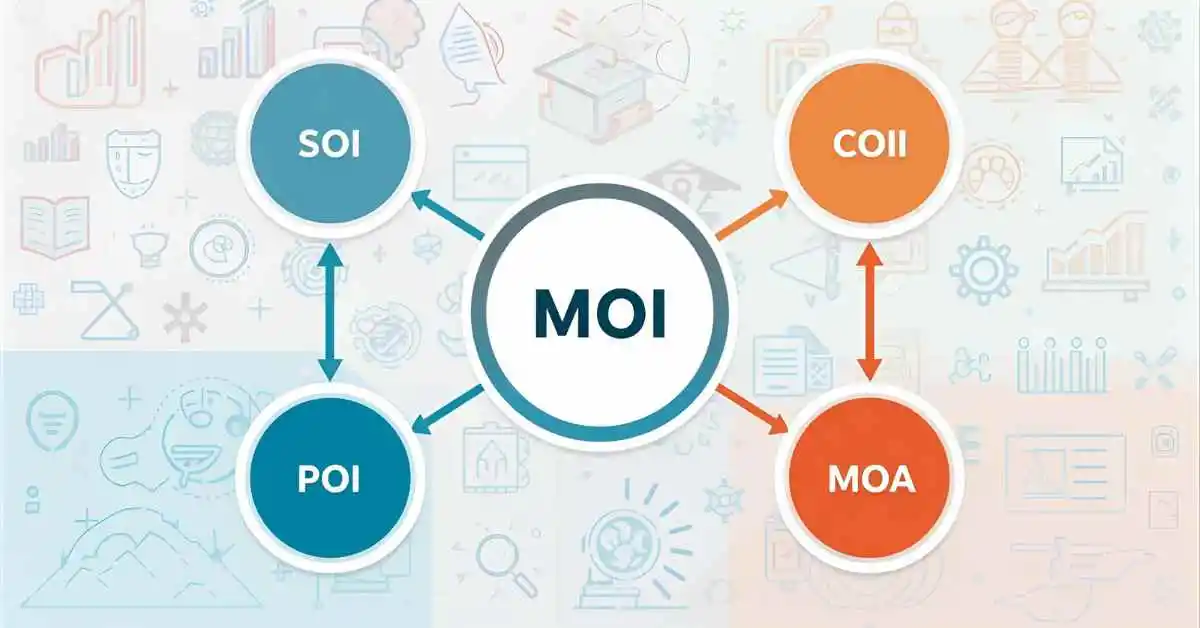
1. SOI – Source of Inspiration
Meaning: Represents motivation or creative drive.
Example: “Her students see her as their SOI.”
When to Use: Use in leadership or mentorship contexts.
2. COI – Circle of Influence
Meaning: The network you can impact directly.
Example: “Stay focused on your COI to drive change.”
When to Use: Best for personal growth and management discussions.
3. POI – Point of Instruction
Meaning: Specific teaching or learning reference.
Example: “At this POI, students learn key grammar rules.”
When to Use: Education or training modules.
4. ROI – Return on Insight
Meaning: Value gained from knowledge or understanding.
Example: “Leadership training improved our ROI.”
When to Use: Business, analytics, or coaching settings.
5. BOI – Basis of Innovation
Meaning: The foundation for new ideas or creativity.
Example: “Curiosity is the BOI behind every invention.”
When to Use: Entrepreneurship, R&D, or startups.
6. TOI – Transfer of Information
Meaning: Communicating data or ideas clearly.
Example: “A strong TOI process improves collaboration.”
When to Use: Corporate training or IT documentation.
7. NOI – Nature of Influence
Meaning: The way someone impacts others.
Example: “Her NOI is calm but powerful.”
When to Use: Psychology, leadership, or marketing.
8. HOI – Habit of Initiative
Meaning: A tendency to take action without being asked.
Example: “He developed a strong HOI early in his career.”
When to Use: Job performance or personal development.
9. LOI – Level of Instruction
Meaning: Depth or difficulty of teaching content.
Example: “Adjust the LOI based on student progress.”
When to Use: Academic curriculum design.
10. FOI – Freedom of Implementation
Meaning: The ability to apply ideas flexibly.
Example: “Our team has FOI in project execution.”
When to Use: Business or creative autonomy discussions.
11. MOA – Method of Approach
Meaning: Strategy or way of tackling something.
Example: “Our MOA improved team engagement.”
When to Use: Planning, coaching, or consultancy.
12. MOT – Method of Training
Meaning: Structured learning process.
Example: “This MOT enhances leadership skills.”
When to Use: Education, HR, or skill development.
13. MOR – Method of Response
Meaning: A standardized reply or reaction style.
Example: “Crisis teams rely on a consistent MOR.”
When to Use: Crisis management, PR, or customer support.
14. MOS – Mode of Support
Meaning: The way assistance is provided.
Example: “We offer both digital and in-person MOS.”
When to Use: Customer service or technical training.
15. MOF – Method of Facilitation
Meaning: Technique used to guide discussion or learning.
Example: “Effective leaders master their MOF.”
When to Use: Coaching, teaching, or workshops.
16. MOC – Method of Communication
Meaning: How information is shared.
Example: “Email is the main MOC for project updates.”
When to Use: Workplace communication or training.
17. MOE – Measure of Effectiveness
Meaning: Metric to assess performance or outcomes.
Example: “Customer satisfaction is our key MOE.”
When to Use: Evaluation and analytics.
18. MOL – Method of Learning
Meaning: Approach taken to understand something.
Example: “Every student has a unique MOL.”
When to Use: Education, coaching, or psychology.
19. MOD – Mode of Delivery
Meaning: The channel or format of instruction.
Example: “Online MODs have revolutionized education.”
When to Use: Training, marketing, or logistics.
20. MOH – Method of Handling
Meaning: Way of managing or resolving an issue.
Example: “He showed professionalism in his MOH.”
When to Use: Leadership or operations.
21. MOM – Method of Management
Meaning: Leadership style or process.
Example: “Her MOM promotes collaboration.”
When to Use: Organizational behavior or HR.
22. MOP – Method of Planning
Meaning: Strategy for structured action.
Example: “A clear MOP ensures timely success.”
When to Use: Project or goal setting.
23. MOQ – Minimum Order of Initiative
Meaning: Basic level of action needed to start.
Example: “Team members must meet the MOQ to qualify.”
When to Use: Business, sales, or performance tracking.
24. MOU – Memorandum of Instruction
Meaning: Written guidance or direction.
Example: “The MOU outlined all key training rules.”
When to Use: Formal communication or military context.
25. MOV – Method of Verification
Meaning: Step to confirm accuracy or quality.
Example: “Every test goes through a MOV process.”
When to Use: Auditing, QA, or compliance.
26. MOW – Method of Work
Meaning: Standardized process or workflow.
Example: “Our MOW ensures consistency.”
When to Use: Industry, factory, or project environments.
27. MOX – Measure of Execution
Meaning: Degree to which tasks are carried out.
Example: “Our MOX improved after automation.”
When to Use: Performance evaluation or operations.
28. MOTI – Method of Technical Instruction
Meaning: Teaching complex technical concepts effectively.
Example: “The MOTI program helps trainers explain coding.”
When to Use: Engineering or software training.
29. MOIN – Method of Initiation
Meaning: The starting approach or introduction style.
Example: “Your MOIN sets the tone for the session.”
When to Use: Leadership, presentations, or workshops.
30. MOIL – Method of Insight Learning
Meaning: Gaining knowledge through reflection and discovery.
Example: “Her MOIL comes from years of observation.”
When to Use: Coaching, research, or self-development.
🧭 Choosing the Right MOI Alternative
- Educational tone: Use POI, LOI, or MOL.
- Technical or engineering tone: Use MOE, MOTI, or MOV.
- Leadership & management tone: Use COI, MOM, MOP, or HOI.
- Creative tone: Choose SOI, BOI, or MOIL.
- Government or formal context: Use MOU or MOA.
Culturally, acronyms like MOI, MOU, and MOA are often formal, while SOI, HOI, or BOI carry motivational or emotional undertones — making tone matching essential for clarity and connection.
🏁 Conclusion: Mastering the MOI Mindset
The MOI acronym goes beyond its literal meanings — it’s about methods, movement, and motivation.
By using these 30 acronym alternatives, you can express the same core idea — teaching, influencing, or initiating — with better tone, precision, and emotional resonance.
Whether you’re writing training material, crafting business documents, or inspiring a team, choose the acronym that mirrors your intent and impact.